
Most teams have some version of a “brand book” or tone‑of‑voice PDF. But when it’s time to write a LinkedIn post, a TikTok caption, or a reply to a spicy comment, no one pauses to dig through a 60‑slide deck. In 2026, when AI is drafting more and more of your social content, that gap between documented voice and actual voice becomes dangerous—and expensive.
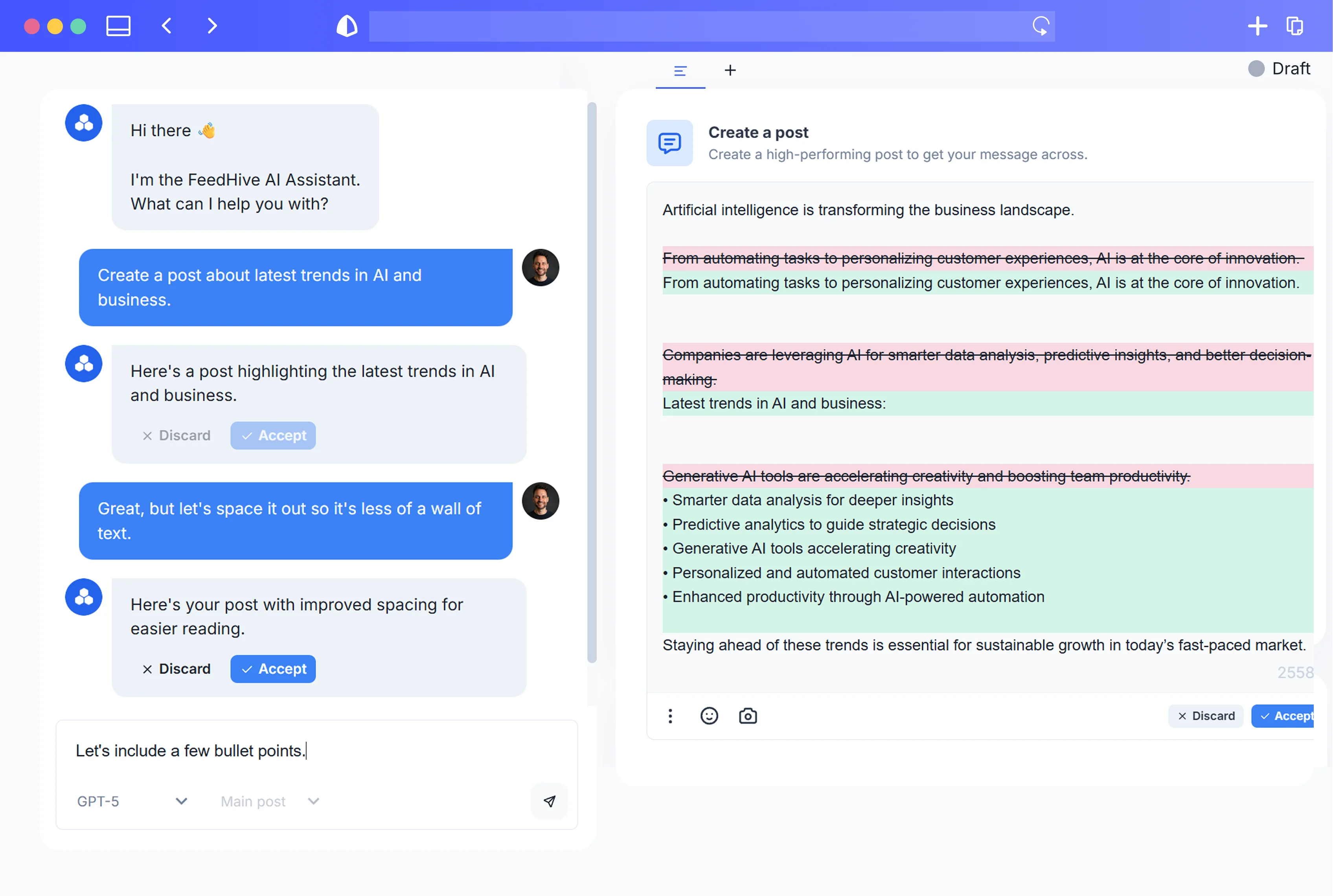
The solution is to turn your scattered guidelines, examples, and instincts into a living “Brand Voice OS” that sits where the work happens and directly shapes how humans and AI write for your brand. Below, you’ll see how to design that system and bring it to life inside a tool like FeedHive, so every AI‑assisted post still sounds unmistakably like you.
Introduction: Why Your Brand Voice PDF Isn’t Enough Anymore
Brand voice consistency is not a fluffy branding ideal; it’s a revenue and trust lever.
- Presenting a brand consistently across platforms can increase revenue by up to 23%, according to research from Marq.
- In Salesforce’s “State of the Connected Customer” 5th edition, 88% of customers say the experience a company provides is as important as its products or services, and 76% expect consistent interactions across departments (Salesforce).
- Edelman’s “In Brands We Trust?” report found 81% of consumers say they must be able to trust a brand before they’ll buy from it (Edelman).
Voice, tone, and messaging consistency across channels are a big part of how customers experience you and decide whether they trust you.
The problem: documentation doesn’t automatically become behavior.
The Content Marketing Institute’s B2B research shows around two‑thirds of B2B marketers say their organization has a content style guide, yet a full third operate without one—and top performers are much more likely to have documented strategies and guidelines than low performers (Content Marketing Institute). Even when a style or voice guide exists, it’s often:
- Static (PDFs, slides, wikis).
- Hard to search or apply in the moment.
- Not wired into the tools people use to actually create content.
So you end up with:
- Great decks no one opens.
- New team members reverse‑engineering “the voice” from whatever posts they see.
- AI tools generating copy in a completely generic tone.
As social content volume explodes and AI becomes the default way to draft it, a static document is no longer enough. You need a system.
What Is a “Brand Voice OS” and Why It Matters in the Age of AI
A “Brand Voice OS” (operating system) is the living system of rules, examples, prompts, and workflows that ensures your brand sounds like itself—no matter who is posting, what channel they’re using, or whether the first draft was written by a human or an AI.
Instead of one dusty PDF, your Brand Voice OS includes:
- A concise core: voice pillars, personality traits, and non‑negotiables.
- Contextual rules: how tone adjusts for different channels, audiences, and situations.
- AI‑ready instructions: reusable prompt blocks, templates, and style snippets.
- A style library: “gold standard” examples for each format.
- Workflows: reviews, approvals, and guardrails that keep AI on‑brand.
- Feedback loops: metrics and processes to refine the system over time.
Why this matters now
Generative AI has moved from experiment to infrastructure.
- In McKinsey’s 2023 global AI survey, 79% of respondents reported at least some exposure to generative AI at work, and 22% said they regularly use it in their own jobs, with marketing and sales among the heaviest users (McKinsey).
- Gartner predicted that by 2025, 30% of outbound marketing messages from large organizations would be synthetically generated, up from less than 2% in 2022 (Gartner).
By 2026, these predictions have largely played out: AI helps draft social posts, emails, ad copy, blogs, and replies every day.
HubSpot’s generative AI research found marketers primarily use AI for content creation tasks—drafting copy, brainstorming ideas, and writing social captions—and that AI helps them create content faster and publish more frequently (HubSpot).
That productivity is only a win if speed doesn’t destroy consistency. Without a Brand Voice OS:
- Every prompt is improvised.
- Every AI output sounds slightly (or wildly) different.
- New team members and freelancers inject their own style into your channels.
- “On‑brand” becomes subjective, debatable, and fragile.
A Brand Voice OS gives AI—and your team—a shared source of truth that is:
- Operational: embedded in your prompts and templates.
- Contextual: aware of channel, audience, and use case.
- Repeatable: easy to reuse across campaigns and brands.
Taking Inventory: Collecting the Raw Materials of Your Brand Voice
Before you can build a system, you need ingredients. Most organizations already have fragments of their brand voice scattered around; your first job is to collect them.
Step 1: Gather every voice‑related asset
For each brand you manage, pull together:
- Brand and tone decks
- Brand positioning documents.
- Tone‑of‑voice PDFs or slides.
- UX writing or microcopy guidelines.
- Content style guides
- Grammar and punctuation rules.
- Terminology and naming conventions.
- Localization guidelines (if applicable).
- Best‑performing content
- Social posts with strong engagement that feel “perfectly on‑brand.”
- Email campaigns your team loves.
- Landing pages that convert and feel “right.”
- Best‑in‑class external references
- Other brands’ style guides you admire.
- Screenshots of posts that “sound like” the direction you want.
Treat this like a discovery project: if someone, somewhere, wrote it down or pointed to it as “this is us,” you want it.
Step 2: Extract what actually defines your voice
Now you’re looking for patterns, not prose. From your pile of documents and examples, highlight:
- Repeated adjectives used to describe your brand (e.g., bold, empathetic, playful, authoritative).
- Signature phrases or constructions that appear often (e.g., “We’ve got your back,” “Here’s the TL;DR”).
- Common sentence lengths and rhythms (short & punchy vs. long & narrative).
- Patterns in point of view (always “we” and “you,” never “I,” etc.).
- Typical humor levels (dry wit, dad jokes, none at all).
- Consistent formality levels (“Hey, folks” vs. “Dear customers”).
- Words and topics that are explicitly banned (e.g., “cheap,” competitor names, sensitive topics).
You can do this in a simple spreadsheet or doc:
- One column for source (deck, post, etc.).
- One for pattern (trait, phrase, rule).
- One for notes (e.g., “only use in B2B context,” “launch campaigns only”).
Step 3: Use best‑in‑class guides as inspiration
If you’re unsure what “good” looks like, look at public style guides from brands that have done this well. For instance, Shopify’s Polaris content guidelines define their voice as “bold, empowering, and helpful,” then back it up with principles, example phrases, and situational guidance (Shopify Polaris).
You don’t copy them—but notice:
- They boil voice down to a few clear traits.
- They show before/after examples.
- They give do/don’t rules that are easy to turn into prompts.
That level of specificity is exactly what your Brand Voice OS needs.
Defining the Core: Pillars, Personality, and Non-Negotiables
With your raw materials collected, you need to distill them into a compact, operational core that everything else will reference.
Voice vs tone: get the foundation right
Nielsen Norman Group draws a clear distinction:
- Voice is your brand’s overall personality—relatively stable over time.
- Tone is how that voice shifts based on context, audience mood, and channel (NN/g).
Think of voice as the character and tone as the mood. Your Brand Voice OS must encode both.
1. Voice pillars (3–5 traits)
Choose three to five adjectives that describe your brand’s personality in practice, not in aspiration. For each trait:
- Define it in your own words.
- Add “do” behaviors: what copy should look/sound like when this trait is present.
- Add “don’t” behaviors: what to avoid, even if it technically fits the adjective.
Example (for a fictional SaaS):
-
Confident, not cocky
- Do: Use clear, decisive language (“Here’s what works; here’s what doesn’t.”).
- Don’t: Insult competitors or customers; no “only idiots do X.”
-
Helpful, not preachy
- Do: Offer practical steps and templates.
- Don’t: Lecture or shame the reader for not knowing something.
These bullets become explicit instructions for AI later.
2. Personality “We are / We are not”
Summarize your personality using contrasts. For example:
- We are plainspoken, not jargon‑heavy.
- We are optimistic, not naive.
- We are witty, not snarky.
- We are direct, not aggressive.
Keep this list short (5–10 lines). It’s incredibly useful for training humans and for informing AI prompts.
3. Non‑negotiables
These are the hard rules your Brand Voice OS must enforce:
- Language rules
- Regional spelling (US vs. UK).
- Capitalization of product names and features.
- Preferred terms (e.g., “customers” vs. “users”).
- Legal and compliance
- Required disclaimers or hashtags (e.g., #ad, #sponsored).
- Phrases you can never use (e.g., “guaranteed results” in regulated spaces).
- Brand protections
- Off‑limits topics (politics, certain jokes).
- Rules about referencing competitors or sensitive events.
Make non‑negotiables explicit and binary: “Always do X,” “Never do Y.” Those are easy to encode in prompts and checklists.
4. Tone ranges by scenario
Define how tone shifts within your stable voice for common social scenarios, such as:
- Product launch announcements.
- Educational how‑tos.
- Customer wins and testimonials.
- Outages, issues, or crisis communications.
- Customer support replies.
- Employer branding posts.
For each scenario, outline:
- Emotion level (neutral, warm, celebratory, serious).
- Formality (casual, polished, formal).
- Humor (none, light, moderate).
- Directness (softly suggestive vs. straight‑to‑the‑point).
This matrix will become the basis for channel‑ and campaign‑specific AI templates.
From Guidelines to Prompts: Translating Brand Voice into AI-Ready Instructions
You now have a clear, human‑friendly definition of your brand voice. The next step is to translate it into machine‑friendly instructions.
Learn from teams that already write this way
Mailchimp’s public content style guide is a good reference. They:
- Distinguish voice (stable) from tone (contextual).
- List a few clear traits (e.g., plainspoken, genuine, human).
- Use a “we are / we are not” table.
- Provide extensive before/after examples (Mailchimp).
If you read their guide as an AI prompt, it’s almost ready to paste: clear traits, dos and don’ts, and concrete examples. That’s the idea.
Use LLM best practices to structure your prompts
Leading model providers explicitly recommend encoding style and voice as structured instructions:
- OpenAI’s GPT best‑practices guide suggests putting critical instructions—like style and tone—in a system message, clearly defining persona and style, and providing examples of ideal outputs (OpenAI).
- Their prompt‑engineering guide recommends being specific, using step‑by‑step instructions, and adding few‑shot examples to steer behavior (OpenAI).
- Google Cloud’s prompt design docs for Vertex AI suggest creating a “style guide” inside the prompt and using examples of brand‑appropriate vs. off‑brand outputs to calibrate the model (Google Cloud).
Your Brand Voice OS should follow the same pattern.
Core components of an AI‑ready brand prompt
For each brand, create a reusable “Brand Voice block” that includes:
-
Role & context
- “You are the social media copywriter for [Brand], writing for [audience] on [channel].”
-
Voice pillars with behaviors
- List your 3–5 traits with short “do/don’t” explanations.
-
Personality contrasts
- Include 5–10 “We are / We are not” lines to narrow interpretation.
-
Non‑negotiables
- Clearly state banned words, topics, and legal constraints.
- Add must‑include elements where relevant (e.g., “Include #ad when post is sponsored.”).
-
Style rules
- Sentence length and structure.
- POV (“Write in second person (‘you’) and first person plural (‘we’).”).
- Emoji and hashtag rules.
- Link and CTA placement.
-
Golden examples
- Paste 2–3 real posts that embody your voice for that channel.
- Label them clearly as examples, not prompts.
-
Off‑brand examples (optional but powerful)
- Include 1–2 examples of what not to do with a line like “Avoid writing like this because it is too salesy/technical/whatever.”
Make your prompts modular
Instead of one giant wall of text, create blocks you can reuse:
- Global brand block – used in every prompt for that brand.
- Channel block – LinkedIn vs. X (Twitter) vs. TikTok vs. Instagram.
- Scenario block – launch, educational thread, crisis update, support reply, etc.
- Compliance block – only appended for certain industries or campaigns.
In practice, your AI prompts inside FeedHive will be built from these blocks:
Global brand voice + Channel rules + Scenario rules + Task
For example:
- “[Global Brand Voice] + [LinkedIn block] + [Thought leadership block] + ‘Draft a post that…’”
- “[Global Brand Voice] + [Instagram block] + [Product launch block] + ‘Write three caption options that…’”
Test and iterate
Before rolling your Brand Voice OS out to the team:
- Run stress tests: ask AI to write in tricky scenarios (e.g., apologizing for an outage) and see if it stays in character.
- Adjust your prompts:
- Add more specific “do/don’t” instructions where it goes off track.
- Add stronger negative examples if needed.
- Tighten or simplify wording if outputs feel diluted.
Your prompts are living artifacts; they will evolve as your brand does.
Building Your Brand Voice OS in FeedHive: Step-by-Step Setup
Once your voice is encoded as prompt blocks and rules, you need to embed it where work happens. That’s where a social media management platform like FeedHive becomes the natural home for your Brand Voice OS.
Step 1: Map brands and channels to your FeedHive setup
- Ensure each brand you manage has:
- Connected social accounts (LinkedIn, X, Instagram, TikTok, etc.).
- Clear naming conventions for channels inside your workspace.
- For agencies: decide how you’ll separate brands (workspaces, folders, or naming conventions).
Remember the scale you’re dealing with: the average social media user actively uses 6.6 platforms per month, according to DataReportal’s 2023 global overview (DataReportal). That’s a lot of surfaces where your voice must stay recognizable.
Step 2: Create a master Brand Voice OS doc per brand
Outside of any tool, maintain a human‑readable “source of truth” that includes:
- Voice pillars and definitions.
- We are / We are not list.
- Tone scenarios.
- Non‑negotiables.
- Full prompt blocks.
- Links to your style library (golden examples).
This doc is your canonical reference. Your AI prompts and FeedHive templates will be copies or subsets of this.
Step 3: Set up AI templates and prompt snippets
Within FeedHive’s AI drafting flows (or wherever you enter prompts):
- Create reusable templates for:
- LinkedIn posts (thought leadership, product updates, hiring).
- X (Twitter) threads and single tweets.
- Instagram and Facebook captions.
- TikTok and Reels descriptions.
- Replies and DMs (if supported).
- Each template should:
- Start with your global Brand Voice block.
- Add the relevant channel block.
- Optionally include a scenario block (launch, educational, etc.).
- Include space for the specific post brief (topic, key message, link).
Name templates clearly, e.g.:
[Brand] – LinkedIn – POV Post – Standard[Brand] – X – Thread – Educational[Brand] – Instagram – Carousel Caption – Product
Step 4: Build a style library inside your workflow
Create an easily accessible repository (shared docs, internal wiki, or notes linked from FeedHive) with:
- 10–20 “gold standard” social posts per channel.
- Short annotations: why they’re good and how they reflect your pillars.
- Examples for tricky scenarios (apologies, pricing changes, product delays).
When using AI:
- Pull 2–3 examples from this library and paste them into the prompt for especially important posts.
- Periodically update the library with new high‑performers.
Step 5: Encode tone variations as separate templates
For each channel, you’ll likely need modes, such as:
- Standard / everyday mode.
- Launch / hype mode.
- Serious / crisis mode.
- Recruiting / employer brand mode.
For each mode:
- Create a variation of your prompt that tweaks tone (e.g., “be more celebratory, use more vivid verbs, slightly increase urgency” for launch mode).
- Save these as separate templates so the team can switch modes without reinventing prompts.
Step 6: Create a pre‑publish brand voice checklist
To make your OS habitual:
- Add a simple checklist to your internal SOPs, so every post (especially AI‑assisted ones) is reviewed for:
- Alignment with 3–5 voice pillars.
- Compliance with non‑negotiables.
- Correct tone for the scenario.
- Factual and legal accuracy.
This can live in your team’s documentation, pinned channel notes, or directly alongside your scheduling workflow so it’s impossible to miss.
Creating Reusable Voice Profiles for Multiple Brands and Campaigns
In‑house teams with multiple product lines and agencies juggling many clients need a way to scale their Brand Voice OS across brands and campaigns.
1. Define a “Brand Profile” schema
For each brand, capture:
- Basics
- Brand name and short description.
- Primary audience segments.
- Voice core
- Voice pillars.
- We are / We are not.
- Non‑negotiables.
- Channel notes
- Per‑channel tone adjustments.
- Platform‑specific do/don’t rules.
- Example library
- Links to “gold standard” posts per channel.
- Campaign overlays
- Key messages and taglines per major campaign.
- Campaign‑specific CTAs and hashtags.
This becomes the “config file” for your Brand Voice OS.
2. Use naming conventions and templates in FeedHive
To keep things manageable when switching brands:
- Prefix templates and assets with brand codes:
ACME – LinkedIn – POVNOVA – Instagram – Launch
- Store brand‑specific prompt blocks where they are easy to copy into AI requests.
- For each campaign, create temporary templates that layer on campaign messaging without changing the underlying voice.
3. Learn from multi‑team ecosystems
GOV.UK’s “Writing for GOV.UK” guide is a classic example of a large, multi‑team organization enforcing a unified voice. It uses:
- Strong plain language rules.
- Clear do/don’t lists.
- Centralized guidance, applied by hundreds of writers across departments (GOV.UK).
Your multi‑brand or multi‑product environment is similar in spirit. A central Brand Voice OS per brand:
- Keeps freelancers, new hires, and agencies aligned.
- Reduces time spent clarifying “does this sound like us?”
- Allows you to safely delegate more content creation to AI while maintaining control.
4. Onboard new collaborators with the OS
Make the Brand Profile the first stop for:
- New team members.
- External writers.
- Agencies or contractors.
Have them:
- Read the profile.
- Review 10–20 example posts.
- Practice generating AI drafts using your templates.
This reduces “voice drift” and flattens the onboarding curve dramatically.
Operationalizing Consistency: Workflows, Approvals, and Guardrails
A Brand Voice OS isn’t just prompts; it’s also process. As AI enters the content stack, leaders are rightly worried about risk.
KPMG’s “Living in an AI World 2023” report highlights that brand reputation, legal exposure, and ethical concerns are among the top barriers to deploying generative AI in customer‑facing contexts (KPMG). Social media is one of the most exposed of those contexts.
To mitigate that risk, embed your Brand Voice OS into your workflows.
1. Define clear roles
For each brand, assign:
- Brand Owner – ultimately responsible for voice and messaging.
- Prompt Architect – configures and maintains AI prompts and templates.
- Content Creator(s) – drafts posts with AI assistance using approved templates.
- Editor/Approver – reviews for brand, tone, and compliance.
- Legal/Compliance (where needed) – reviews sensitive content or campaigns.
2. Build a “human in the loop” approval flow
Use your scheduling tool to enforce a simple path:
- AI draft
- Creator uses Brand Voice OS templates to generate a draft.
- Human edit
- Creator refines, adds nuance, and checks facts.
- Brand review
- Editor or Brand Owner checks:
- Voice pillars present.
- Tone matches scenario.
- Non‑negotiables respected.
- Editor or Brand Owner checks:
- Compliance review (if required).
- Schedule/publish.
No AI‑generated content should go straight from model to live without human review—especially in regulated industries or high‑risk scenarios.
3. Add guardrails at three levels
-
Prompt level
- Encode banned topics, tone limits, and legal constraints directly into prompts.
- Include instructions like “If asked to do X, politely decline and explain why.”
-
Tool level
- Restrict who can edit brand templates and prompts.
- Consider requiring approval for posts tagged as “AI‑assisted” before publishing.
-
Policy level
- Write an internal policy covering:
- When AI can be used (drafting yes; final review no).
- What types of content must be fully human‑written.
- How to handle AI mistakes or misfires (correction protocols).
- Write an internal policy covering:
4. Train your team to use the OS
Don’t assume people will find or follow the system on their own. Run explicit training on:
- How to pick the right template for a given scenario.
- How to adjust prompts without breaking guardrails.
- How to review AI outputs specifically for voice and tone.
Reinforce that the OS exists to make their work faster and easier—not more bureaucratic.
Measuring Success: How to Track and Refine Your Brand Voice Over Time
If you want your Brand Voice OS to stay healthy, you need feedback loops. Measure both consistency and performance.
1. Audit your own channels for voice consistency
Once a month or quarter:
- Sample posts from each channel and brand.
- Create a simple scorecard:
- For each post, rate how well it reflects each voice pillar (e.g., 0–3).
- Note any violations of non‑negotiables.
- Flag posts whose tone feels off for their context.
Look for patterns:
- Certain channels veering off‑voice?
- Certain creators or teams struggling?
- Certain scenarios (e.g., crisis posts) drifting from guidance?
Use this data to adjust training and prompts.
2. Track performance of OS‑driven content vs. ad‑hoc content
Using your analytics (inside your social tool or separately):
- Tag posts created via Brand Voice OS templates.
- Compare them against:
- Engagement rate (likes, comments, shares, saves).
- Click‑through rate and conversion (where trackable).
- Follower growth over time.
You’re looking for:
- Performance stability across channels.
- Any uplift in engagement or clarity comments (“Love how you explain this,” “This is so helpful”).
3. Measure workflow improvements
Your Brand Voice OS should also make content easier to produce:
- Time from brief to scheduled post.
- Number of revision cycles per post.
- Percentage of AI drafts approved with light vs. heavy edits.
If AI‑assisted posts using the OS are moving faster with fewer rewrites, that’s a strong internal ROI signal.
4. Use findings to improve the OS itself
Treat your OS as a product:
- Quarterly, review:
- Which pillars are working.
- Which rules feel too rigid or too vague.
- Where AI still struggles (e.g., humor, certain topics).
- Update:
- Voice definitions and examples.
- Prompt blocks and templates.
- Style library with new “gold standard” posts.
Document version changes so teams know when and why voice rules evolved.
Advanced Use Cases: Experiments, A/B Tests, and Seasonal Voice Shifts
Once your Brand Voice OS is stable, you can use it as a controlled environment for experimentation instead of improvisation.
1. A/B test tone within your allowed range
Because your OS defines acceptable tone ranges, you can safely test edges without going off‑brand.
Examples:
- On LinkedIn:
- Variant A: more formal, data‑driven version of a post.
- Variant B: more conversational, story‑led version.
- On Instagram:
- Variant A: minimal emojis, direct CTA.
- Variant B: more expressive, playful tone.
Use your AI templates to generate both variants by tweaking the tone block (e.g., “slightly increase humor” vs. “keep tone strictly professional”). Monitor which version performs better and feed that learning back into your defaults.
2. Seasonal and campaign “voice modes”
Your OS can include temporary modes for:
- Holiday seasons.
- Major product launches.
- Industry events (conferences, trade shows).
- Crisis or sensitive periods.
For each mode:
- Define what changes:
- Vocabulary (e.g., holiday metaphors, event hashtags).
- Emotion and energy level.
- Types of stories you highlight.
- Create dedicated templates:
[Brand] – LinkedIn – Holiday Mode[Brand] – Instagram – Launch Mode
When the season or campaign ends, you simply switch back to standard templates.
3. Channel‑specific experiments with a shared spine
Because your global voice is stable, you can:
- Loosen tone more on TikTok while staying recognizable.
- Lean into authority and depth on LinkedIn.
- Be more playful on Instagram Stories.
Use channel blocks in your prompts to adjust the dials, then analyze how far you can stretch per channel without losing recognizability.
4. Multilingual and regional adaptations
For international brands:
- Define a base Brand Voice OS in your primary language.
- Work with native‑speaking writers to create localized voice OSes:
- Translate pillars in spirit, not literally.
- Adjust cultural references and humor.
- Update non‑negotiables and banned topics per region.
Use AI to assist with draft translations, but insist on human review to ensure local correctness and cultural fit.
5. Applying the OS to replies and community management
Your Brand Voice OS shouldn’t stop at outbound posts.
- Define guidelines for:
- Responding to praise.
- Handling complaints.
- Dealing with trolls or misinformation.
- Create AI templates for reply suggestions that:
- Reflect your voice pillars.
- Follow escalation and apology protocols.
- Never promise actions or outcomes your team can’t deliver.
This keeps everyday interactions as on‑brand as your polished campaigns.
Common Pitfalls When Using AI for Brand Voice (And How to Avoid Them)
Even with a solid Brand Voice OS, there are traps to avoid.
Salesforce’s marketing research around AI notes that, while marketers see huge productivity potential, they’re particularly worried about ensuring AI outputs are accurate, on‑brand, and compliant (Salesforce). Those concerns map directly to the most common mistakes.
1. Treating AI as autopilot
Pitfall:
- Letting AI generate and publish content with minimal human oversight.
Fix:
- Keep humans in the loop for every customer‑facing piece.
- Use AI for drafting and ideation; use humans for judgment, nuance, and accountability.
2. Writing vague or overloaded prompts
Pitfall:
- Prompts that say “be professional but friendly,” or multi‑page instructions the model ignores.
Fix:
- Use specific, operational language: “Use short, punchy sentences,” “Avoid buzzwords like ‘synergy’.”
- Keep prompts modular and focused; test and refine regularly.
3. Confusing voice with tone
Pitfall:
- Radically changing “who” the brand sounds like for different campaigns or channels.
Fix:
- Keep your core voice consistent (pillars and personality).
- Only adjust tone based on context, staying within defined ranges.
4. Skipping negative examples
Pitfall:
- Only providing “good” examples and never showing what off‑brand looks like.
Fix:
- Include a few “don’t do this” examples in your OS, with explanations.
- Use these to calibrate both humans and AI.
5. Ignoring non‑negotiables under deadline pressure
Pitfall:
- Approving AI copy that technically “reads well” but violates small brand or legal rules.
Fix:
- Bake non‑negotiables into prompts, templates, and checklists.
- Assign a specific reviewer to own compliance.
6. Letting the OS get stale
Pitfall:
- Never revisiting your Brand Voice OS after launch.
Fix:
- Treat the OS as a living system with owners and version history.
- Update it with new examples, rules, and findings at least quarterly.
7. Failing to train new team members
Pitfall:
- Assuming templates alone are enough and skipping training.
Fix:
- Make OS onboarding mandatory for anyone touching social.
- Provide short training sessions and quick reference guides.
Conclusion: Turning Brand Voice into a Competitive Advantage with FeedHive
In a world where AI drafts a large share of marketing messages, brand voice becomes one of the few durable ways to stand out. But that voice can’t live only in a slide deck—it has to live in your tools, prompts, examples, and workflows.
By:
- Taking inventory of your existing voice assets.
- Distilling them into clear pillars, personality, and non‑negotiables.
- Translating those into AI‑ready prompts and modular blocks.
- Embedding them in your social workflows and templates inside a platform like FeedHive.
- Creating reusable brand and campaign profiles.
- Adding approvals, guardrails, and measurement loops.
…you turn “tone of voice” from an abstract ideal into a practical, daily system. Every AI‑assisted post—no matter the channel, campaign, or creator—gets pulled toward the same, recognizable brand personality.
Teams and agencies that build this kind of Brand Voice OS now will ship faster, stay safer, and sound more consistent than competitors still improvising prompts. In 2026, that isn’t just good branding; it’s a real competitive advantage.