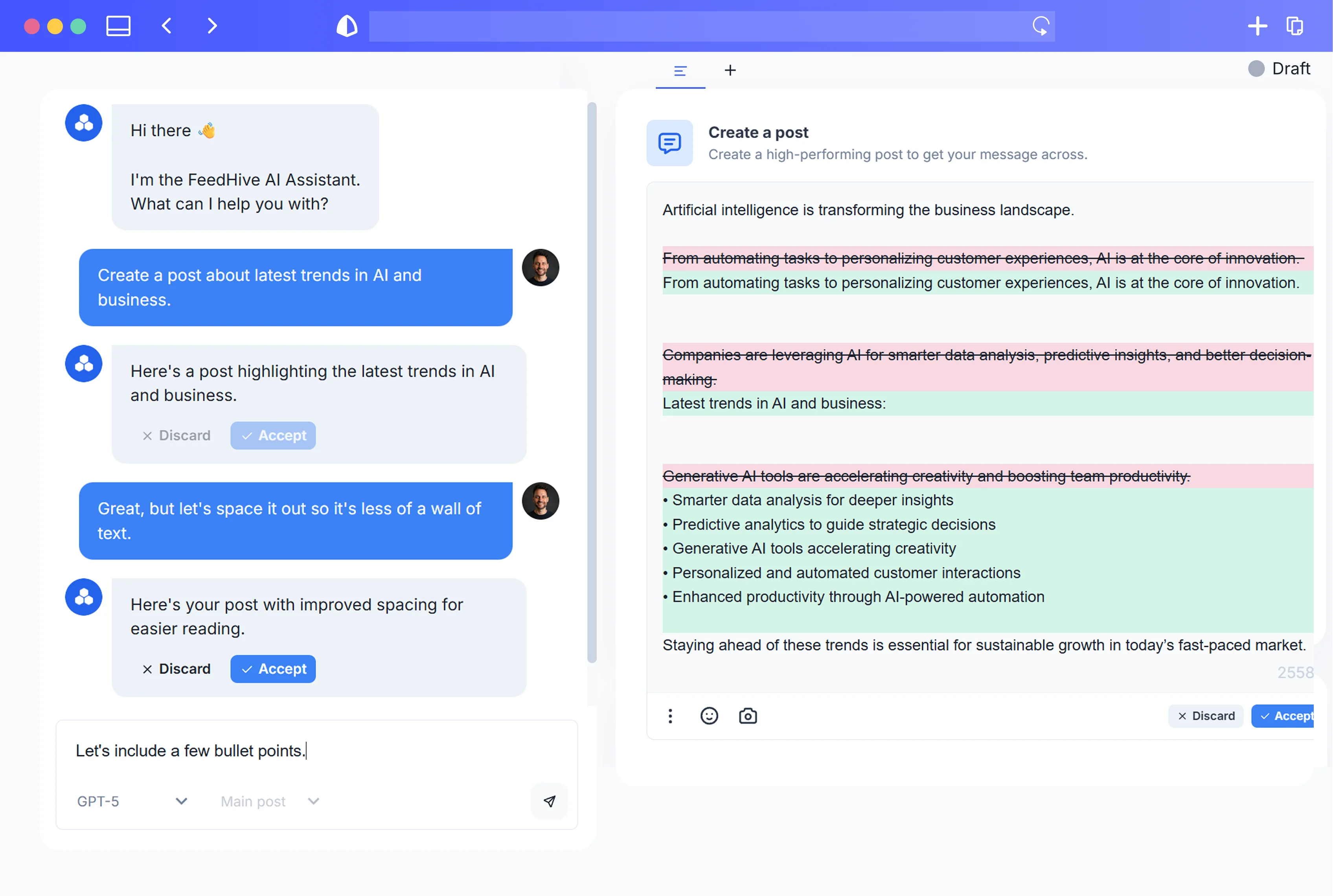


The job you signed up for as a social media manager is not the job you’ll be doing in 2026.
Caption writing, manual scheduling, and one‑off reporting are being swallowed by AI, templates, and automation. What’s emerging in their place is a higher‑leverage role: the person who designs the content systems, orchestrates AI tools, and turns messy performance data into repeatable playbooks.
Think of it as evolving from “the person who posts” to “the person who directs the entire social AI stack.”
This guide breaks down what that role looks like, the five core skills you need, and how to deliberately upskill over the next 90 days so you’re leading the change instead of being replaced by it.
Why the Social Media Manager Role Is Changing in 2026
A few structural shifts are converging at once:
1. You’re being asked to do more with less
Social teams are stretched thin and expected to produce harder business outcomes.
- Hootsuite’s 2024 Social Media Trends report found that 42% of social media marketers are being asked to do more with the same resources, and 31% are expected to drive revenue without additional budget. At the same time, 68% of organizations now use social data to inform other departments (sales, product, customer service), and 60% say social insights increasingly influence brand strategy, with 39% sharing social insights with executive leadership at least monthly. 29% are already using AI or machine learning to optimize posting times and content formats (Hootsuite Social Trends 2024, Nov 2023).
- Sprout Social’s 2023 Index reports that 51% of social marketers manage more than five social accounts, and 69% work on teams of three or fewer (Sprout Social Index 2023).
Translation: more channels, more stakeholders, more revenue pressure—without more people. Scaling your impact now depends on systems and AI, not hustle alone.
2. Social is becoming “connective tissue” in the business
Because social sits closest to the customer, its insights are bleeding into nearly every function. Hootsuite’s numbers above show social data informing strategy, product, sales, and leadership decisions.
A recent LinkedIn analysis of global marketing jobs shows social media manager roles increasingly share skills with “digital marketing manager” and “marketing strategist”—with data analysis, marketing strategy, and content strategy growing in prevalence in social job postings from 2019–2023, while pure execution skills (like basic community management) grow more slowly (LinkedIn Marketing Jobs Data Spotlight, 2023).
Social pros who can interpret data and communicate insights are being pulled into:
- Go‑to‑market planning
- Product launch strategy
- Customer research and feedback loops
- Executive reporting
3. AI is shifting which skills are valued
The World Economic Forum’s Future of Jobs 2023 report projects that 75% of companies will adopt AI by 2027, with “AI and big data specialists” among the fastest‑growing roles and routine execution jobs among the fastest declining. It also names analytical thinking and creative thinking as the top two core skills for workers by 2027 (WEF, Future of Jobs 2023).
For social media, that means:
- The execution of posting is increasingly automated.
- The thinking around what to say, how to say it, and how to systematize it becomes your primary value.
In other words: jobs built on manual posting are at risk; jobs built on designing AI‑powered content systems are on the rise.
From Poster to Architect: What an AI Director Actually Does
By 2026, the most valuable social pros will look less like “channel admins” and more like AI Directors for social.
They’ll still understand copy, culture, and community—but their real leverage comes from architecting the machine that produces content, learns from results, and keeps improving.
The mandate of an AI Director for social
At a high level, an AI Director:
-
Designs content systems, not single posts
- Builds reusable frameworks (series, pillars, campaigns) that AI can help populate.
- Sets rules: what to post, where, when, and why.
-
Orchestrates an AI tool stack
- Chooses and integrates AI tools for writing, design, video, scheduling, and analytics.
- Builds prompt libraries and workflows so others can get consistent outputs.
-
Runs ongoing experiments
- Treats every post as part of a test plan.
- Uses AI to generate variations, then measures and documents what works.
-
Turns data into playbooks
- Translates dashboards into clear rules like “for X segment, Y format with Z hook wins.”
- Updates prompt templates, content calendars, and guidelines based on those rules.
-
Owns AI governance for social
- Defines what’s acceptable, what needs human review, and how to avoid legal or brand risks.
- Coordinates with legal, security, and leadership on responsible use.
Why this role has outsized leverage
McKinsey’s 2023 global study on generative AI found that marketing and sales is one of the top three business functions already seeing the highest reported revenue uplift from gen AI, through use cases like personalized marketing and content generation. They estimate a 5–15% productivity uplift in marketing and sales spend from gen‑AI adoption (McKinsey, 2023).
The AI Director is the person who captures that uplift for your brand by:
- Turning “one‑off experiments” into permanent systems.
- Ensuring time saved by AI is reinvested into strategy, creativity, and insight, not just more random posts.
- Aligning what AI produces with actual business outcomes, not vanity metrics.
To step into that role, you need a very specific skill stack.
The 5 Core Skills of an AI-Augmented Social Lead
You don’t need to become a data scientist or a full‑stack engineer. But you do need a blend of creative, analytical, and governance skills that map directly onto how AI is being adopted in marketing.
IBM’s 2023 Global AI Adoption Index found that among organizations already using AI:
- 34% say reskilling and upskilling current employees in AI is a top priority, and
- 26% cite lack of AI skills and expertise as a primary barrier to adoption.
- At the same time, 44% say governance, compliance, and risk management are major challenges, and 38% report lacking clear internal guidelines on responsible AI use (IBM Global AI Adoption Index 2023).
That’s the gap you can fill.
Here are the five core skills that define an AI‑augmented social lead:
- Prompt design – Getting consistent, on‑brand, high‑quality output from AI tools.
- Experiment design – Running structured tests on content, prompts, and audiences.
- Data literacy – Going beyond vanity metrics to tie social to business impact.
- Governance & ethics – Keeping AI use safe, compliant, and on‑brand.
- Creative direction – Owning the big ideas and using AI as a creative multiplier.
Let’s break each down.
Skill 1: Prompt Design for Consistent, On-Brand Output
Prompt design is not a party trick. It’s a formal discipline that determines whether AI is a helpful junior creative…or an off‑brand chaos machine.
Why prompt design matters
Two big patterns show how critical this skill is:
- HubSpot’s 2024 State of AI in Marketing report found that 64% of marketers already use AI tools in their day‑to‑day role, and among them 70% say generative AI helps them create content faster and 65% say it improves content quality. Critically, 53% of marketers with AI training say they “often” get usable first‑draft content from AI, compared with just 29% of untrained peers (HubSpot, 2024).
- Microsoft’s 2024 Work Trend Index reports that 78% of “AI power users” (those saving 10+ hours per month) say they’ve developed custom prompting techniques and workflows, compared to 34% of casual users (Microsoft Work Trend Index 2024).
The difference between “meh” outputs and “this is 80% done for me” is prompt skill.
The building blocks of strong social prompts
Think of prompts as mini‑briefs you give an extremely fast intern. Great prompts are:
-
Context‑rich
Include your brand, audience, offer, and goal.- Who are we?
- Who are we speaking to?
- What are we promoting?
- What action do we want?
-
Constraint‑driven
Set clear boundaries.- Platform (LinkedIn vs TikTok)
- Format (thread, carousel, short video script)
- Length limits
- No‑go topics or phrases
-
Voice‑anchored
Supply examples and guidelines.- 2–3 past posts that nailed your voice
- Style rules (“plain language,” “no jargon,” “first person plural”)
- Brand personality sliders (e.g., playful vs formal)
-
Example‑based
Ask AI to mimic structures that work.- “Use this post as a structure template, but adapt to [new topic].”
Turning prompt design into a system
An AI Director goes beyond ad‑hoc prompting and builds a prompt library:
-
Brand‑level prompts
- “Summarize our brand voice and style from these 10 posts.”
- “From this summary, act as our in‑house social media copywriter.”
-
Format‑specific prompts
- Hook writing for Reels or Shorts
- LinkedIn thought‑leadership posts
- Twitter/X threads
- Email + social combinations for launches
-
Workflow prompts
- Draft → tighten → add hooks → localize for specific markets.
- Turn long‑form assets (webinars, blogs) into multi‑week social series.
In day‑to‑day work, this means you:
- Spend less time writing from scratch.
- Spend more time choosing angles, editing for nuance, and aligning outputs with strategy.
Skill 2: Experiment Design for Systematic Content Testing
When AI can generate 20 variations of a caption in seconds, the bottleneck moves from “coming up with ideas” to “figuring out what actually works.”
That’s where experiment design comes in.
High‑performing marketers are experiment‑driven
A 2023 Gartner survey of CMOs found that 71% of high‑performing marketing organizations describe themselves as “experiment‑driven”, running frequent tests on creative, audiences, and messaging—compared with 29% of low‑performers (Gartner CMO Spend & Strategy 2023–2024).
Harvard Business Review has similarly documented how companies like Booking.com run thousands of concurrent online experiments, and that organizations which institutionalize A/B testing see significantly higher growth rates than those that don’t (HBR, “The Surprising Power of Online Experiments,” 2019).
As AI multiplies how many creative variants you can make, your ability to design good tests becomes a superpower.
How to think like an experiment designer
At minimum, every serious test needs:
-
A clear hypothesis
- “If we lead with problem‑first hooks instead of feature‑first hooks, we’ll increase click‑through rate by 20%.”
-
Defined variables
- Independent variable: the thing you change (e.g., hook, visual style, CTA, posting time, prompt template).
- Dependent variable: the outcome you measure (e.g., CTR, saves, replies, trial signups).
-
A controlled setup
- Change one thing at a time where possible.
- Keep audience, time window, and budget (for paid) comparable.
-
Minimum sample / duration
- Enough impressions or clicks to avoid jumping to conclusions based on random noise.
- A consistent time period (e.g., at least several posting cycles) before you declare a winner.
-
A codified learning
- Document the result: “For audience X, hook style A beats hook style B by 30%.”
- Update your playbooks and prompts accordingly.
Where AI fits into experimentation
AI helps you:
-
Generate structured variant sets
- “Create 10 alternative hooks for this post, each emphasizing a different emotion.”
- “Rewrite this caption for three audience segments: founders, CMOs, and creators.”
-
Scale multivariate tests
- Combine variations in hooks, CTAs, and visual treatments far faster than manual creation.
-
Automate analysis support
- Summarize experiment results and surface patterns (e.g., which angles correlate with higher saves or replies).
As an AI Director, you’re not just testing posts; you’re testing:
- Prompt templates
- Content formats and sequences
- Cadence and timing
- AI‑assisted workflows vs manual ones
And then feeding those learnings back into your systems.
Skill 3: Data Literacy Beyond Vanity Metrics
You can’t direct an AI‑driven content system if you don’t know what “good” looks like in numbers.
The current data gap in marketing
Despite having more dashboards than ever, marketers still struggle to use data:
- A 2022 Gartner survey found that only 53% of marketing decisions are influenced by marketing analytics, often because teams lack confidence in interpreting or acting on the data (Gartner, Marketing Data and Analytics Survey 2022).
- The Data Literacy Project’s 2023 survey reports that only 24% of employees feel fully confident in their data literacy skills, yet 89% say data literacy will be important for their job by 2028, with marketing and sales among the functions with the largest perceived gaps (The Data Literacy Project, 2023).
This is your opportunity: if you can read the numbers and translate them into clear direction, you become indispensable.
What “data literacy” actually means for social pros
You don’t need advanced statistics. You do need to:
-
Know which metrics matter
Move beyond follower counts and likes to:- Engagement rate, saves, and shares
- Click‑through rate and cost per click
- Lead volume and quality
- Revenue or pipeline influenced by social
- Retention and customer success signals (e.g., product usage upticks after campaigns)
-
Understand basic comparisons
- Week‑over‑week and month‑over‑month trends
- Campaign vs baseline performance
- Organic vs paid contribution
-
Spot patterns and anomalies
- Which topics, formats, or hooks repeatedly over‑ or under‑perform
- Performance differences by audience segment, region, or platform
-
Tell stories with data
- “When we used educational carousels instead of product screenshots, saves increased by 40% and demo requests from organic social rose by 18%.”
Turning data into repeatable playbooks
As an AI‑augmented lead, you use data to:
-
Update prompts
- If curiosity‑driven hooks outperform fear‑based ones, your default hook prompt changes: “Write 5 curiosity‑driven hooks that tease a surprising benefit without fear‑mongering.”
-
Refine content pillars
- Double down on themes that generate both engagement and pipeline; retire those that don’t.
-
Design sequences
- Use data to map effective content journeys (e.g., “3 educational posts → 1 case study → 1 direct CTA”) and encode them into calendars and automation rules.
Data literacy is what lets you “steer” the AI engine instead of just watching numbers go up or down.
Skill 4: Governance, Ethics, and Brand Safety with AI
The more you rely on AI, the higher the stakes if something goes wrong—legally, ethically, or reputationally.
The governance gap in marketing AI
Salesforce’s 2023 Generative AI Snapshot: Marketing survey (1,000+ marketers) found that:
- 73% are already using generative AI, and 71% believe it will help them focus on more strategic work.
- But only 23% say their organization has clear, company‑wide guidelines for using it.
- 63% are concerned about security and privacy, 59% worry about inaccurate information, and 56% are concerned about bias in AI outputs (Salesforce, 2023).
At the same time, the EU’s AI Act—the first broad regulation of AI—emphasizes transparency, data quality, and human oversight for higher‑risk AI systems. While social content generation isn’t classified as “high‑risk,” the Act is expected to push companies toward more formal AI governance frameworks across all use cases (European Commission, EU AI Act Fact Sheet, updated 2024).
An AI Director for social is often the first line of defense here.
What governance looks like in practice
Your responsibilities typically include:
-
Tool evaluation
- How do tools handle data?
- Do they train on your prompts/content?
- Where is data stored? Is it compliant with your industry and geography?
-
Usage policies
- What kinds of content can be AI‑generated vs must be human‑written?
- Which sources must be used for factual claims?
- What level of human review is required before publishing?
-
Prompt and output governance
- Maintain a vetted prompt library in a shared repository.
- Document which prompts are approved for which use cases.
- Log significant AI‑generated content (e.g., campaigns, offers) for auditing.
-
Brand and legal alignment
- Collaborate with legal, compliance, and HR to define red‑lines (e.g., no medical/legal advice, no claims that violate advertising standards).
- Train your team on disclosing AI use where necessary.
-
Bias and inclusion checks
- Regularly review AI outputs for biased or stereotypical language.
- Include diverse reviewers in the loop.
By leading governance, you become the person the organization trusts to scale AI safely—which is exactly what leadership is looking for as regulations catch up.
Skill 5: Creative Direction in an AI-Heavy Workflow
AI can draft endlessly, but it can’t (yet) own taste, insight, or genuine originality. That’s your job.
Creators see AI as a multiplier, not a replacement
Adobe’s 2023 Future of Creativity study found that 70% of creators and marketers believe generative AI will help them be more creative, not less, and 68% say it will free up time for more strategic and conceptual work (Adobe, 2023).
Similarly, Canva’s 2023 Visual Economy report shows that 75% of marketing and creative pros use AI tools to speed up repetitive design tasks, but only 25% trust AI to independently create final campaign concepts without human oversight (Canva Visual Economy Report 2023).
The market clearly expects humans to keep owning the big ideas.
What creative direction looks like in an AI era
As an AI‑augmented creative lead, you:
-
Set the narrative
- Decide the core themes your brand will champion over quarters, not days.
- Frame the brand’s POV on key industry debates.
-
Define emotional targets
- Is this campaign meant to provoke, reassure, educate, or inspire?
- You use AI to generate options, but you decide what feels right.
-
Shape campaigns as story arcs
- Map teaser → reveal → proof → community participation.
- Use AI to brainstorm posts for each chapter of the arc.
-
Curate and refine, not just accept
- Ask AI for 20 ideas, then combine and twist them with your own insights.
- Push beyond obvious angles and clichés.
-
Guard brand nuance
- Humor levels, taboo topics, ethical boundaries—these come from you.
- AI’s role is to express that nuance at scale, not invent it.
A practical creative workflow with AI
-
Brief first, prompts later
- Write a tight creative brief (audience, problem, message, proof, emotion).
- Then translate it into prompts for different formats.
-
Generate many, select few
- Use AI for idea volume.
- Shortlist only the strongest concepts, then enrich them.
-
Prototype quickly
- Rough out scripts, carousels, or storyboards using AI.
- Share internally for feedback early.
-
Refine with human insight
- Add product nuance, stories from customers, inside jokes from your niche.
- Polish language and visuals so they feel unmistakably “you.”
Creative direction is how you avoid your brand sounding like every other AI‑assisted feed out there.
Building Your Personal AI Stack as a Social Pro
To operate like an AI Director, you need more than a single tool—you need a stack that works together.
Step 1: Map your workflows
List your recurring tasks:
- Strategy and planning
- Ideation and research
- Copywriting and scripting
- Design and video
- Scheduling and publishing
- Community management
- Reporting and insights
Identify where you’re spending the most time and where mistakes or delays are most costly. These become your highest‑leverage automation and AI opportunities.
Step 2: Choose AI building blocks
A typical AI stack for social might include:
-
Foundation models
- General‑purpose LLMs (ChatGPT, Claude, Gemini, etc.) for research, ideation, drafting, and summarization.
-
Specialized copy tools
- Tools focused on marketing copy, email, and ads for speed and structure—used on top of a strong prompt strategy.
-
Design and video AI
- Image generation or editing tools.
- Video editors with AI features (auto‑captions, filler‑word removal, scene detection).
-
Social media management platforms
- Scheduling and queueing across channels.
- Content recycling and repurposing.
- Tagging, UTM management, and workflow automation.
-
Analytics and listening tools
- Native platform analytics (Meta, LinkedIn, TikTok, YouTube).
- Web analytics (GA4) and attribution.
- Social listening for brand, competitor, and topic monitoring.
Step 3: Integrate into cohesive workflows
Rather than treating tools as separate apps, design end‑to‑end flows, such as:
-
From idea to multi‑channel campaign
- Use an LLM to turn product updates and customer feedback into content ideas.
- Generate draft posts and scripts.
- Use design/video tools to create assets.
- Push into your scheduler with tags, UTMs, and experiment labels.
- After publishing, pull performance data into a summary and update your playbooks.
-
From long‑form to evergreen content engine
- Feed a webinar transcript into your LLM.
- Generate a 4‑week content calendar of posts derived from it.
- Design assets and schedule.
- Automatically recycle top performers on a recurring schedule.
The AI stack you build becomes part of your personal value proposition as a marketer: you’re not just “good with tools,” you’re the architect of efficient, insight‑driven workflows.
Practical Ways to Showcase AI Fluency on Your Resume and Portfolio
Hiring managers are already screening for AI skills. You want your resume and portfolio to make that obvious before you get to the interview.
The demand is visible in the job market
LinkedIn’s 2024 Future of Work report shows that job posts mentioning AI or GPT receive 17% more applications per job, and AI‑related skills on member profiles have grown 21x globally since late 2022 (LinkedIn, Future of Work 2024).
A 2023 ResumeBuilder survey of 1,000+ hiring managers found that 91% of companies hiring for marketing roles prefer candidates with generative AI experience, and 55% have created new roles or significantly changed existing ones because of gen AI (ResumeBuilder, 2023).
The Chartered Institute of Marketing reports that 59% of marketers believe they’ll need “significant retraining” in data and AI tools within the next five years, and 35% say their current role already requires more data skills than it did two years ago (CIM, “The Impact of AI on Marketing,” 2023).
So how do you stand out?
How to phrase AI skills on your resume
Move beyond vague lines like “familiar with AI tools.” Instead, show:
-
Specific capabilities
- “Prompt design & LLM orchestration for social content”
- “AI‑driven experimentation and A/B testing”
- “Marketing data storytelling and dashboard creation”
- “AI governance and brand safety frameworks”
-
Concrete impact
Under each role, add bullets like:- “Implemented AI‑assisted content system that reduced time‑to‑publish by 40% while increasing average engagement rate by 25%.”
- “Designed and ran 15+ AI‑powered A/B tests on hooks and CTAs, increasing click‑through rate on LinkedIn ads by 32%.”
- “Built governance guidelines for generative AI use across social channels, cutting content review time by 50% without increasing brand risk.”
-
Named tools + workflows
- “Used [tool] + [tool] to transform webinars into 6‑week cross‑channel campaign sequences, measured through GA4 and CRM data.”
What to include in your portfolio
Go beyond screenshots of posts. Include:
-
Before/after case studies
- Show how AI changed your workflow and results.
- “Before: 4 posts/week manually written. After: 12 posts/week via AI‑assisted system, with 2x engagement and clear audience segmentation.”
-
Prompt and workflow examples
- Redacted, if needed, but enough to demonstrate structure.
- Show how you iterate prompts based on performance data.
-
Experiment summaries
- A slide or page per experiment: hypothesis, setup, results, and what you changed going forward.
-
Governance artifacts
- A trimmed version of your AI usage guidelines.
- A flowchart of your review and approval process.
This kind of evidence screams “I can operate at AI Director level,” even if your current title still says “Social Media Manager.”
Interview Stories and Case Studies That Prove Your AI Skills
By the time you get to an interview, hiring managers want proof you can do the work, not just talk about tools.
They’re also increasingly advertising for these skills: LinkedIn’s Economic Graph analysis in 2023 recorded a 3x increase in AI‑related job postings mentioning “GPT” or “generative AI” in just one quarter, often including responsibilities like “writing and refining prompts” for large language models (LinkedIn Economic Graph, 2023).
Expect questions like:
- “How are you using AI in your current role?”
- “Tell me about a time you improved performance using generative AI.”
- “What risks do you see with AI in marketing, and how do you mitigate them?”
Prepare STAR‑formatted stories (Situation, Task, Action, Result) around each of the five skills:
1. Prompt design story
- Situation: “We needed to triple content volume for a product launch without more headcount.”
- Task: “Create a scalable way to generate on‑brand copy for multiple channels.”
- Action: “Built a prompt library for launch content, including tone guidelines and examples. Trained the team on how to use and adapt the prompts.”
- Result: “We increased output by 3x with similar or better engagement, and reduced last‑minute rewrites by 60%.”
2. Experiment design story
- Situation: “Engagement on our educational posts plateaued.”
- Task: “Find a more compelling angle.”
- Action: “Used AI to generate 10 new hook styles, then ran structured A/B tests over six weeks, changing only hooks while keeping content constant.”
- Result: “Identified two hook patterns that lifted click‑through rates by 35%, which we then rolled into our content playbook.”
3. Data literacy story
- Situation: “Leadership questioned whether organic social was driving pipeline.”
- Task: “Prove or disprove social’s impact on revenue.”
- Action: “Implemented UTM tagging, set up dashboards, and used AI to summarize performance across channels, linking campaigns to CRM opportunities.”
- Result: “Demonstrated that social influenced 18% of new pipeline in the quarter, securing budget for more experimentation.”
4. Governance story
- Situation: “The team started using AI tools informally, raising concerns about accuracy and compliance.”
- Task: “Bring order and safety to AI use.”
- Action: “Audited tools, created AI usage guidelines, set up a review workflow, and trained the team on fact‑checking and bias checks.”
- Result: “No compliance incidents, smoother approvals, and 50% faster content turnarounds.”
5. Creative direction story
- Situation: “Our brand voice felt generic and interchangeable with competitors.”
- Task: “Differentiate our storytelling.”
- Action: “Led a repositioning workshop, defined a new narrative, then used AI to explore angles and formats while personally curating and refining final concepts.”
- Result: “Improved share of voice and a 2x increase in brand‑search volume over six months.”
Have 1–2 solid stories ready for each skill. That’s how you prove you’re ready for a more strategic, AI‑centered role.
Using FeedHive as Your Personal Social ‘AI OS’
A key shift in 2026 is thinking of your social tool not just as a scheduler, but as an operating system for your AI‑powered content engine.
FeedHive describes itself as an AI‑powered social media management platform that helps you plan, write, and schedule content. According to its product pages, it offers:
- AI writing assistance for generating post drafts and variations.
- AI‑driven post recycling and repurposing, turning high‑performing posts into new content.
- Smart scheduling that suggests optimal posting times.
- Automations and rules to run recurring content series and workflows at scale (FeedHive Features & AI, accessed Jan 2026).
This is exactly the kind of environment where an AI Director thrives. For example, you can:
- Store and iterate on prompt templates directly where your content lives.
- Tag posts by experiment (hook style, topic, audience) and use performance data to refine your templates.
- Set up recurring sequences—like onboarding flows, evergreen tips, or “best of” compilations—powered by AI repurposing.
- Run your entire social operation as a set of systems and automations, not just manual queues.
The more thoughtfully you design these systems, the more leverage you get from every hour you and your tools spend.
Common Pitfalls When Adopting AI (and How to Avoid Them)
Moving fast with AI can easily backfire. Watch for these traps:
1. Tool hoarding without workflows
- Pitfall: Signing up for every shiny AI app and never integrating them.
- Fix: Start from your workflows, not from tools. Add new tools only when you can clearly place them in an end‑to‑end process.
2. Shallow prompting
- Pitfall: Using vague prompts (“Write a good caption about our product”) and blaming AI for mediocre output.
- Fix: Invest time in building structured prompts and libraries. Treat each refinement as an asset you’ll reuse.
3. Over‑automation with no human review
- Pitfall: Letting AI publish unreviewed content to “save time,” risking off‑brand or inaccurate posts.
- Fix: Keep a human‑in‑the‑loop for anything customer‑facing. Use AI for drafts and ideation; humans for judgment and final sign‑off.
4. Ignoring data
- Pitfall: Loving how fast AI generates content, but never checking whether it actually works.
- Fix: Tie AI‑generated content to specific experiments and KPIs. If performance isn’t improving, change your prompts, formats, or hypotheses.
5. Keeping AI skills siloed
- Pitfall: Becoming the only person who “knows the prompts,” creating bottlenecks and risk.
- Fix: Document your systems, train your team, and encourage shared ownership. That actually increases your value as the person who designed the system.
Remember: you’re not judged on how cleverly you use AI once—you’re judged on the reliability and repeatability of the system you build around it.
A 90-Day Learning Roadmap to Evolve into an AI Director
You don’t have to transform overnight. Here’s a practical 90‑day plan.
Days 1–30: Foundations and personal workflows
Goals: understand tools, nail the basics of prompting, and free up time.
-
Audit your current week
- List every recurring social task and estimate time spent.
- Highlight the most repetitive, low‑judgment tasks.
-
Pick 1–2 core AI tools
- One general LLM (e.g., ChatGPT or similar).
- One social management platform with AI features.
- Avoid adding more until you’re using these deeply.
-
Learn prompt fundamentals
- Create at least 5 reusable prompts:
- Brand voice summarization
- Post drafting for your main platform
- Hook generation
- Repurposing long‑form content
- Summarizing performance reports for execs
- Create at least 5 reusable prompts:
-
Apply AI to your own workflow
- Use AI to draft and refine your next week of posts.
- Track how much time you save and where outputs still need work.
Days 31–60: Experimentation and data literacy
Goals: start thinking like a scientist and a strategist.
-
Design 2–3 simple experiments
- Example: test two hook styles across several posts.
- Example: test two different CTAs for the same offer.
-
Set up tags and tracking
- Use UTMs and post tags so you can attribute performance correctly.
- Build a simple spreadsheet or dashboard capturing key metrics.
-
Use AI to assist with analysis
- Ask AI to summarize weekly performance and spot patterns.
- Compare AI’s “take” with your own; refine prompts until summaries are accurate and useful.
-
Document learnings
- Create a living doc for “What works for our audience,” updating it after each experiment.
- Start turning these into adjusted prompts and content rules.
Days 61–90: Governance, playbooks, and leadership
Goals: formalize your system and demonstrate leadership value.
-
Draft AI usage guidelines for social
- What’s allowed, what’s not, and when human review is required.
- How to fact‑check, handle sensitive topics, and avoid bias.
-
Create your first playbook
- Choose one content pillar or campaign type.
- Document: strategy, prompts, templates, workflows, metrics, and sample posts.
- Make it something another marketer could run with minimal hand‑holding.
-
Share and train
- Run a short internal session walking colleagues through your AI workflows.
- Invite feedback and iterate.
-
Package your progress
- Turn your 90‑day journey into:
- Resume bullets with metrics
- A case study in your portfolio
- Stories for future interviews
- Turn your 90‑day journey into:
By the end of 90 days, you won’t just “know AI tools”—you’ll have designed, documented, and led AI‑powered systems. That’s exactly what an AI Director does.
Conclusion: Future-Proofing Your Social Media Career in the Age of AI
The social media role is changing fast:
- Routine tasks like basic caption writing and scheduling are being automated.
- Social data is informing company‑wide decisions.
- AI is becoming core infrastructure in marketing, not a side project.
In that environment, the most valuable people are those who can:
- Design strong prompts.
- Run disciplined experiments.
- Read and communicate data.
- Build and enforce governance.
- Provide unmistakably human creative direction.
Think of yourself less as “the person who posts” and more as the architect of your brand’s social AI system.
If you deliberately build that skill stack, assemble a thoughtful AI toolset, and document the systems you create, you won’t just survive the next wave of AI—you’ll be the one leading it.